What American Generals Said When a British Commander Refused Their Orders in Kosovo
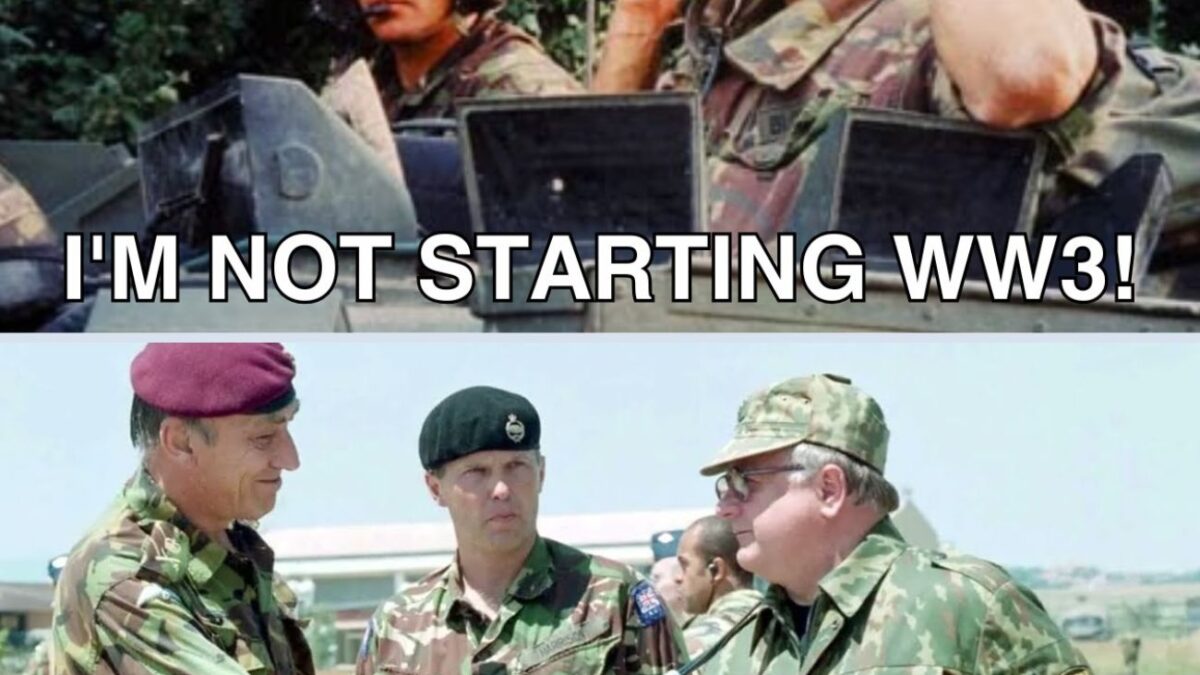
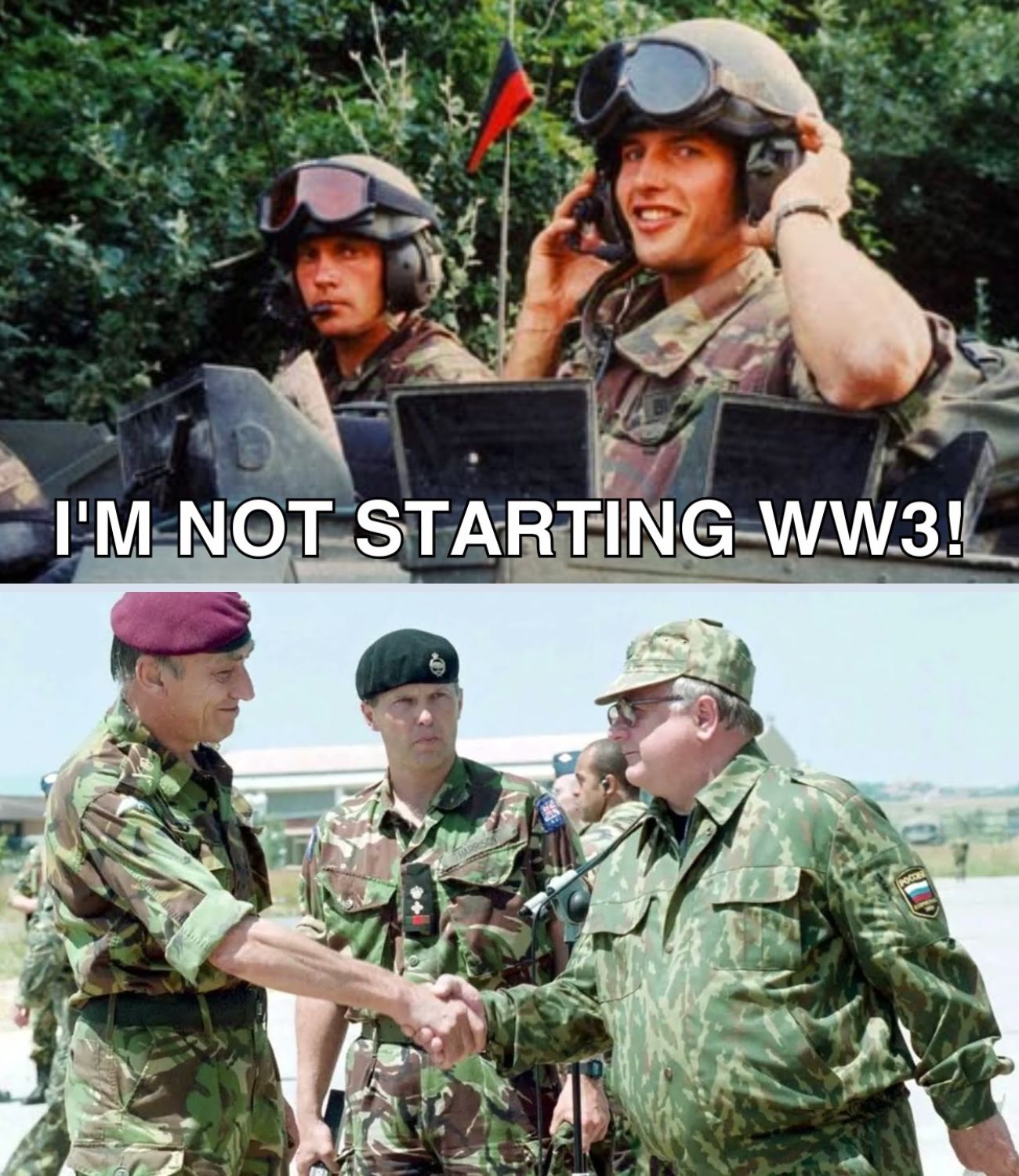
On June 12th, 1999, a 25-year-old British cavalry officer named James Blunt led a column of armored vehicles to the gates of Pristina Airport in Kosovo and found 200 Russian soldiers pointing weapons directly at his men. The order that came crackling down the radio from the American four-star general commanding all of NATO was simple. Attack the Russians and take the airport by force. But the British general commanding every NATO soldier on the ground heard that order, stepped in, and told the most powerful military commander in the Western world something no one expected. He said, “I’m not going to start the third world war for you.” So, what happened when a British officer looked America’s top general in the eye and said no? And how did a flask of whiskey in a bombed-out airport terminal stop a war between two nuclear powers from starting?
It was just after 5:00 in the morning on June 12th, 1999, and the air over the Macedonian border smelled of diesel fumes and dry summer dust. Captain James Blunt sat inside an armored reconnaissance vehicle at the head of a long column of NATO troops stretching back along the road for miles. He was 25 years old. He was an officer in the Life Guards, one of the two regiments of the Household Cavalry, and he had volunteered to join a Blues and Royals Squadron specifically for this deployment to Kosovo. And he’d been educated at Harrow School and trained at the Royal Military Academy Sandhurst. And strapped to the outside of his vehicle, alongside the radio antennae and ammunition boxes, was a guitar. Blunt was not yet the man the world would come to know. He had not yet written “You’re Beautiful.” He had not yet sold 12 million copies of his debut album. He had not yet topped the charts in 13 countries. All of that was years away. On this morning, he was simply a young officer leading the reconnaissance screen for 30,000 NATO troops pushing into Kosovo from the south. His job was to move fast, move first, and report back what he found. What he found at Pristina Airport changed his life and very nearly changed the world.
The airport sat on the outskirts of Kosovo’s capital city. It was battered and scarred from 78 days of NATO bombing. The terminal building was wrecked. The runways were cracked. And dug in around the perimeter behind sandbags and inside armored vehicles with the letters K4 freshly painted over where S4 had been just hours earlier were 200 Russian soldiers pointing their weapons directly at Blunt and his men. Nobody had told NATO the Russians were coming. Nobody had approved their presence. These were paratroopers from the Russian peacekeeping force in Bosnia who had driven more than 600 km through the night at high speed racing to seize the airport before NATO could arrive. They had painted new markings on their vehicles as they drove. It was a stunt. It was a provocation. Oh, and it was about to become one of the most dangerous standoffs of the entire post-Cold War era.
Blunt pulled his vehicles back a short distance and radioed headquarters. The response did not come from his British chain of command. It came from the American four-star general who commanded all NATO forces in Europe. General Wesley Clark, the Supreme Allied Commander. Clark’s order was clear. Overpower the Russians. Seize the airport. Block the runways to prevent reinforcements from landing. Words like destroy came across the radio. Behind Blunt were paratroopers from the Parachute Regiment. Men who were, in Blunt’s own words, obviously game for the fight. If the order was carried out, 200 Russian soldiers would be attacked by a vastly superior NATO force, and Russia had thousands more paratroopers on standby at airbases across the country. The consequences of opening fire on Russian troops would not stay contained to a single airport in the Balkans. Everyone on that radio frequency knew it. Blunt later said he would have refused the order and faced a court-martial rather than attack. But he did not have to make that choice alone. Because the British three-star general in command of every NATO soldier on the ground, a man named Mike Jackson, heard the order, stepped in, and delivered a line that would echo through military history for decades. He told the Supreme Allied Commander of Europe, “I’m not going to start the Third World War for you.”
What followed was a standoff between two nuclear powers, an argument between two generals, a flask of whiskey shared in the rain, and a decision that ended one man’s career and made the other a legend. This is the story of the British general who said no to the Supreme Allied Commander of Europe and was proven right.
To understand what happened at Pristina Airport, you have to understand what tore Kosovo apart in the first place. Yugoslavia was a country held together by force. For decades, a communist government kept six republics and dozens of ethnic groups under one flag. When communism collapsed in the early 1990s, the country shattered along every line that had been papered over for half a century. Wars broke out in Croatia and Bosnia. Hundreds of thousands of people were killed or driven from their homes. NATO intervened in Bosnia in 1995 with airstrikes and then a peacekeeping force. But the worst was not over.
Kosovo was a province in southern Serbia. About 90% of its people were ethnic Albanian. Throughout the 1990s, the Serbian government under President Slobodan Milošević stripped Kosovo of its rights and imposed brutal repression on the Albanian population. By 1998, a guerrilla movement called the Kosovo Liberation Army was fighting Serbian security forces and the Serbian response was devastating. Villages were burned. Civilians were executed. Hundreds of thousands of Albanians were driven from their homes in a campaign of ethnic cleansing that shocked the world. Diplomacy failed. The Rambouillet peace talks collapsed when Serbia refused to allow NATO troops on its soil. On March 24th, 1999, NATO launched Operation Allied Force, a massive bombing campaign against military targets in Serbia and Kosovo. It was the first time in the alliance’s 50-year history that it had used military force against a sovereign nation without approval from the United Nations Security Council. The decision was controversial. Russia, Serbia’s traditional ally, was furious, but the bombing went ahead.
Britain was at the center of it from the start. British special forces from 22 SAS secretly crossed into Kosovo before the first bombs fell, moving through enemy territory to locate Serbian troop positions and identify targets for NATO aircraft. Captain James Blunt and his reconnaissance troop from the Blues and Royals worked along the Macedonia-Yugoslavia border, directing forces and painting targets for the air campaign. The RAF flew Tornado and Harrier jets on combat missions. Britain was not a junior partner in this war. It was one of the driving forces behind it.
The bombing lasted 78 days. More than 38,000 combat sorties were flown. Cities were hit. Bridges were… Power stations went dark. But on the ground, the Serbian army survived almost completely intact. The bombs had forced Milosevic to the negotiating table, but they had not destroyed his military. His soldiers were still in Kosovo. They were still armed. They were still dangerous. And they were angry. Someone was going to have to go in on foot and make sure they actually left. That someone was Lieutenant General Mike Jackson of the British Army.
Jackson was not a man who had learned war from textbooks. He was a parachute regiment officer who had served three tours in Northern Ireland during the worst years of the Troubles. He had been present as a young adjutant at the Ballymurphy massacre in 1971 when British soldiers killed 10 unarmed civilians. He was at Bloody Sunday in 1972 when 14 more unarmed people were shot dead. Those events did not break him, but they marked him forever. He understood, at a level that went deeper than any briefing paper could reach, what happened when soldiers used disproportionate force in politically charged environments. One wrong decision could destroy everything.
By 1997, Jackson had been appointed commander of NATO’s Allied Rapid Reaction Corps, the sharp end of the alliance’s ground forces. When Kosovo needed a ground commander, Jackson was the obvious choice. He was given command of KFOR, the Kosovo Force, a multinational army from Britain, France, Germany, Italy, and the United States, and numbering more than 30,000 soldiers in total. His boss in the NATO chain of command was American General Wesley Clark. Clark was the Supreme Allied Commander Europe, the most powerful military position in the Western Alliance. He was brilliant, ambitious, and aggressive. He had pushed hard for the bombing campaign and had clashed repeatedly with the Clinton administration over the scale and intensity of military operations. Clark wanted results, and he wanted them fast. These two men, one British, one American, one cautious, one aggressive, were about to collide over a ruined airport in the Balkans.
The Kosovo War officially ended on June 11th, 1999. Serbia agreed to pull its forces out of the province. NATO would move in the following morning. Everything was planned. Routes were mapped. Rules of engagement were agreed. The multinational force was assembled in Macedonia, engines running, ready to roll. Then the Russians moved.
It was about half past 10:00 in the morning on June 11th. Mike Jackson and American Admiral James Ellis, Clark’s deputy and technically Jackson’s direct superior, were standing in the KFOR operations room in Skopje, Macedonia. They had turned on a television hoping to see news coverage of the peace deal. What they saw instead made both men freeze where they stood. On the screen was a column of Russian armored vehicles driving out of Bosnia into Serbia at high speed. The vehicles had the letters K4 painted in white where S4 had been. A news presenter explained that viewers were watching the Russian contingent of the Kosovo peacekeeping force heading toward Pristina. Jackson and Ellis looked at each other. For KFOR did not have a Russian contingent. Nobody had told them this was happening. Nobody had given permission. 250 Russian paratroopers, soldiers who had been serving as peacekeepers in Bosnia, were racing 600 km across Serbia toward Kosovo’s capital. They were heading for Pristina Airport and they were going to get there before NATO did.
Before Jackson and Ellis could fully process what they were seeing, the phone rang. They both knew who was calling. Wesley Clark had seen the same footage and he was already on the line. Clark’s instinct was immediate. Stop the Russians. He ordered British and French paratroopers to be flown by helicopter to the airport and seize it before the Russians could dig in. About 500 paratroopers would be carried in by Chinook helicopters and dropped directly onto the airfield. The plan had serious problems. The helicopters would have to fly over Serbian-held territory. The peace agreement did not technically take effect until the next day. The Serbian army, still intact, still armed, still angry about the bombing, might see helicopters crossing their positions and open fire. If a Chinook went down in those mountains, there was no way to rescue the crew by road. And then the French pulled out. The French government heard about the plan and refused to participate. They would not send their soldiers on an unauthorized mission that might restart the war. British paratroopers from the 5th Airborne Brigade sat in a scorching cornfield next to their Chinook helicopters all afternoon waiting for an order that never came. Jackson canceled the operation. The risk was too great. The Russians were going to reach the airport first.
The next morning, June 12th, the advance began. The 5th Airborne Brigade flew into Kosovo at dawn to secure the Kaçanik Gorge, a narrow, 10-mile-long mountain pass that was the only route for NATO armor to reach Pristina. If the Serbs blocked it, the entire operation would stall. Ahead of the main body moved Captain James Blunt and his reconnaissance troop. They drove through a landscape scarred by war, burned villages, empty homes with doors hanging open, the evidence of mass killings. Albanian refugees were already beginning to return. Some of them throwing flowers at the NATO vehicles as they passed. The column slowed. Blunt pressed on. When his vehicles reached the outskirts of Pristina Airport, the situation became clear in an instant. Russian soldiers were dug in around the entire perimeter. They were armed. They were alert. And they were not going anywhere.
A Russian sentry stepped forward and aimed his weapon at the lead British vehicle. Behind him, soldiers with rocket-propelled grenades watched from fortified positions. Blunt pulled back and called for orders. The response came not from his British headquarters, but from General Wesley Clark. The order was to overpower the Russian force, block the runway, prevent reinforcements from landing. The word destroy came through the radio. James Blunt stared at 200 armed Russian soldiers and listened to an American general tell him to attack them.
Mike Jackson heard the order. He had spent his entire career watching what happened when soldiers followed orders without thinking about what came next. Northern Ireland had taught him that. Bloody Sunday had taught him that. He was not going to let a general sitting in a headquarters in Belgium start a shooting war with Russia over a bombed-out runway in Kosovo. Jackson got on the radio to Blunt. His instructions were clear and calm. Do not block the runway. Do not engage the Russians. Encircle the airport. Hold your position. Wait.
Then Jackson confronted Clark directly. Clark repeated his order. Block the runways. Prevent Russian aircraft from landing. Isolate the Russian force. Jackson refused. His words were blunt and final:
“Sir, I’m not going to start the Third World War for you.”
Clark pushed back. He was a four-star general. Jackson was a three-star. And in NATO’s command structure, Clark outranked him by an entire level. The order was legitimate. The chain of command was clear. Jackson did not budge. He told Clark:
“Sir, I am a three-star general. You can’t give me orders like this. I have my own judgment of the situation, and I believe that this order is outside our mandate.”
Clark replied:
“Mike, I am a four-star general, and I can tell you these things.”
It did not matter. Jackson was prepared to resign his command that night rather than carry out the order. He had his letter of resignation mentally drafted. He knew what attacking Russian soldiers would mean. He knew that Russia had thousands of paratroopers on standby. He knew that Russian airbases were preparing for any escalation that might come. He knew that 200 soldiers at an airport in Kosovo could become the first shots of a conflict between two nuclear-armed powers. And he was not going to let that happen because an American general wanted to assert dominance. Admiral James Ellis, Clark’s own deputy and technically Jackson’s direct superior in the chain of command, also refused the order. The American officers below Clark had looked at the situation and reached the same conclusion as the British. This was not worth a war.
But Jackson did not simply refuse and walk away. He acted. That evening, he flew by helicopter into Pristina. He landed at the airport. And he went to meet the Russian commander face-to-face. The Russian in charge was Major General Viktor Zavarzin. He was a two-star general leading a force that was isolated, exposed, and 600 km from the nearest friendly support. Jackson found him in the wrecked airport terminal. Rain was hammering down outside. The building was damaged, dark, and cold. The atmosphere was tense. Nobody knew what would happen next. Jackson was known for two things besides soldiering, whiskey and cigars. He reached into his jacket and pulled out a hip flask. He offered it to the Russian general. Zavarzin accepted. Standing in a bombed-out terminal in the pouring rain, a British three-star general and a Russian two-star general shared a flask of Scotch whiskey and began to talk.
The conversation warmed. Jackson could see that the Russians were actually frightened, not of NATO, but of the Kosovo Liberation Army, which viewed Russia as an ally of Serbia and might attack the airport at any moment. And the 200 Russian soldiers were surrounded, outnumbered, and vulnerable. Jackson offered a deal. He would send British soldiers to protect the Russian perimeter from KLA fighters. He sent a detachment that included his own son, Captain Mark Jackson, who was serving in Kosovo at the time. He sent them with another bottle of whiskey. The crisis was diffused, not with American firepower, not with a four-star general’s orders, with a British officer’s judgment, a hip flask, and the courage to say no.
The diplomatic negotiations dragged on for days after the standoff. Russia demanded an independent peacekeeping sector in Kosovo. NATO refused. The Western alliance feared that giving Russia its own zone would split Kosovo in two, an Albanian south and a Serbian north. That kind of partition would have created exactly the kind of ethnic division the entire intervention had been launched to prevent. Eventually, both sides reached a compromise. Russian peacekeepers would deploy throughout Kosovo, but they would operate independently of the NATO command structure. They would not have their own exclusive sector. The political standoff ended the same way the military one had, with neither side getting everything it wanted, but with nobody firing a shot.
Behind the scenes, the United States applied pressure on every country between Russia and Kosovo. Bulgaria, Hungary, and Romania were all asked, firmly, to deny Russia access to their airspace. Without the ability to fly reinforcements into Pristina, the Russian force at the airport was stranded. Their bold dash had made a political statement, but without support from the air, it had no strategic weight. 200 soldiers cannot hold an airport forever when the entire NATO force surrounds them. Britain’s 53 Field Squadron Royal Engineers eventually reactivated Pristina Airport as a military airbase in October 1999. Civilian flights resumed shortly after.
The crisis was truly over, but the consequences for the men involved were just beginning, and the Americans had plenty to say about what the British had done. General Wesley Clark wrote a book about the war called Waging Modern War. In it, and in interviews that followed, he gave his version of events. He described the moment Jackson refused his order as a surprising moment to me in a PBS interview, and he said Jackson was extremely agitated and emotional and making all kinds of statements. In a later interview with Radio Free Europe, he called Jackson’s famous line about World War III a hyperbolic statement that had no basis in reality. But then, he added something that told the real story. I have sympathy for him. He was exhausted. He worked hard to negotiate the peace agreement. He was very tired and very emotional. Clark never called Jackson a coward. He never said Jackson was wrong about the risks. He called him emotional and then acknowledged that the man had done more work on the ground than anyone else in Kosovo.
But Clark was not the only American who weighed in. General Hugh Shelton, the chairman of the US Joint Chiefs of Staff, the highest-ranking military officer in the United States, called Jackson’s refusal troubling. In hearings before the United States Senate, Senator John Warner went further. He suggested that Jackson’s refusal to follow a direct order from the Supreme Allied Commander might have been illegal and that if it was legal, perhaps the rules should be changed to prevent it from happening again. American military circles were divided. Some believed Clark had been right to assert NATO authority. Others quietly admitted that Jackson had prevented a disaster.
What settled the argument was what happened next. Clark was informed 1 month after the Pristina incident that he would be removed from his position as Supreme Allied Commander Europe. He was replaced early. Shelton himself made the decision and Clark had spent the entire Kosovo campaign clashing with the Clinton administration over how aggressively to prosecute the war. His repeated push for escalation and his willingness to risk a confrontation with Russia were the final straw. His NATO career was finished. He later ran for president of the United States in 2004 and did not win.
On the British side, the response could not have been more different. British Chief of the Defense Staff General Sir Charles Guthrie had been on the phone with Clark and Jackson during the standoff. He sided with Jackson completely. When Clark asked Guthrie to overrule his own general, Guthrie spoke to Jackson privately and then backed his decision. The British chain of command, from the general on the ground to the chief of the military in London, had stood united against the American order. General Mike Jackson was not disciplined. He was not reprimanded. He was not quietly transferred to a desk somewhere. The opposite happened. The British government and the British public celebrated what he had done. He was awarded the Distinguished Service Order for his leadership in Kosovo. He was knighted, appointed Knight Commander of the Order of the Bath. In 2003, he was promoted to Chief of the General Staff, the professional head of the entire British Army. He held the post until he retired in 2006 after nearly 45 years of military service. The British tabloid newspapers gave him a nickname that stuck for the rest of his life. They called him Macho Jacko.
Admiral James Ellis, Clark’s deputy, the American officer who was technically Jackson’s direct superior, had also refused Clark’s order. He had rejected the plan to land helicopters on the runway. The American chain of command below Clark had sided with the British. That fact is often forgotten in the retelling of the story, but it matters. It was not simply Britain versus America. It was measured judgment versus reckless escalation. And the measured side had officers from both countries.
Captain James Blunt left the British Army in 2002. He took his guitar, the same instrument he had carried strapped to the outside of his armored vehicle in Kosovo, and moved into a flat in the London home of actress Carrie Fisher. There, he wrote much of his debut album, Back to Bedlam. Released in 2004, it became the best-selling album of the entire decade in the United Kingdom. You’re Beautiful reached number one in 13 countries including Britain and the United States. The soldier who had stared down 200 Russian guns at Pristina Airport became one of the biggest selling musicians on the planet.
But the significance of what happened at that airport went far beyond the careers of the men who were there. The standoff at Pristina Airport revealed something about NATO that no amount of planning documents or summit declarations could have exposed. It showed that the alliance’s two most powerful members, the United States and the United Kingdom, had fundamentally different instincts when it came to the use of force. The American approach under Clark was aggressive, escalatory, and focused on dominance. Seize the ground, assert control, show strength. The British approach under Jackson was measured, politically aware, and focused on outcomes. Understand the situation, calculate the risks, or find a solution that avoids catastrophe even if it means disobeying an order.
These two philosophies had clashed before, and they would clash again in Afghanistan, in Iraq, and in the ongoing deployments along NATO’s eastern flank. But the Kosovo incident was the purest example. An American general wanted to attack Russian soldiers over an airport. A British general understood that no airport on earth was worth a war between nuclear powers. The American was fired. The British officer was promoted. History made its judgment clear.
The incident also established a template for British military leadership within NATO coalitions that continues to this day. Be professional. Be firm. Be willing to exercise independent judgment. Do not blindly follow orders that risk catastrophe. And this philosophy was not born at Pristina. It was forged in Northern Ireland where British soldiers had learned the hard way that one wrong decision could turn a population against you. It was reinforced in Bosnia where peacekeeping demanded diplomacy as much as firepower. And it was proven on a global stage in Kosovo where a British general’s refusal to attack saved NATO from a disaster of its own making.
The Russian dimension of the story is just as important. For Moscow, the Kosovo intervention was deeply humiliating. The Balkans had traditionally been within Russia’s sphere of influence. NATO had bombed Serbia, Russia’s ally, without even seeking approval from the United Nations Security Council which Russia could have vetoed. The airport dash was a protest disguised as a military operation. It was Russia saying to the world, “We are still here. We are still capable, and you cannot ignore us.” Jackson understood this. He did not treat the Russians as enemies to be destroyed. He treated them as soldiers who had made a bold move and now needed a way out that preserved their dignity. The whiskey, the handshake, the offer of protection from the KLA, these were not signs of weakness. They were the acts of a commander who understood that the best victories are the ones where nobody has to fire a shot.
That lesson would prove prophetic. The pattern of Russian behavior at Pristina, bold, provocative moves designed to test Western resolve and exploit divisions within NATO, would repeat itself again and again over the next two decades. In Georgia in 2008, in Crimea in 2014, in Ukraine in 2022. Each time, the question was the same. Would NATO respond with force or with judgment? The answer often depended on which nation was leading the response.
James Hillier Blount was born in a military hospital in Tidworth, Wiltshire. His father was a colonel in the Army Air Corps. He grew up moving between England, Cyprus, and Germany following his father’s postings the way all military children do, packing up, saying goodbye, starting again. He was commissioned into the Life Guards and could have spent his career in comfortable postings. Instead, he volunteered for Kosovo. Kosovo was his first operational deployment. He did not have to go. He volunteered specifically to join D Squadron of the Blues and Royals for the mission. He carried his guitar with him throughout the entire campaign. When his unit stopped in friendly villages, he would sometimes sit with local families, share a meal, and play music for them. The contrast between the soldier directing NATO air strikes on Serbian positions and the musician playing guitar in village squares says everything about the kind of man Blount was and the kind of army that produced him.
When the order came from Clark to overpower the Russians at the airport, Blount was the first man who had to process it. He told the BBC years later:
“I was given the direct command to overpower the 200 or so Russians who were there. I was the lead officer with my troop of men behind us. The soldiers directly behind me were from the Parachute Regiment, so they’re obviously game for the fight.”
He said he questioned the order the moment it came through that attacking Russian soldiers over an airport was something he could not have lived with. After leaving the army in 2002, Blount pursued music full-time. His debut album, Back to Bedlam, became a global phenomenon, but he never forgot Kosovo. In 2008, he returned to film a documentary called Return to Kosovo, retracing the route he had driven in his armored vehicle. He visited the people and places he had encountered as a soldier. He became a patron of Help for Heroes and a supporter of Medecins Sans Frontieres, an organization he had first discovered while on operations in Kosovo. He is one of the few people alive who can say they helped prevent a confrontation between NATO and Russia and then went on to sell 12 million albums.
Jackson had seen violence spiral out of control more times than most soldiers could imagine. Beyond what he witnessed in Derry and Belfast as a young officer, he was at the Warren Point ambush in 1979 when the IRA killed 18 British soldiers with two roadside bombs, the worst single loss of life for the British Army during the Troubles. He carried those experiences with him for the rest of his career and they shaped every decision he ever made under pressure. After Kosovo, Jackson led the British Army through some of its most demanding years. He was Chief of the General Staff during the Iraq War and the early stages of the Afghanistan deployment to Helmand Province. He oversaw an army stretched to its limits across two wars simultaneously. He retired in 2006 after nearly 45 years of service.
And Jackson was famous for his gravelly voice. Journalists described it as fine-tuned by whiskey and cheroots. He had enormous bags under his eyes, so pronounced that he had them surgically removed after retirement. He insisted it was a matter of vision, not vanity. His troops called him Darth Vader and the Prince of Darkness because of his temper and that deep rumbling voice. But they followed him because they knew he would never ask them to do something reckless. Mike Jackson died on October 15th, 2024 at the age of 80. He was the first commander of KFOR. The man who shared whiskey with a Russian general in the rain. The man who told the Supreme Allied Commander of Europe that he was not going to start the Third World War. He was buried with the full honors of the British Army.
The Norwegian special forces soldiers who were actually the first NATO troops to encounter the Russians at the airport have been largely forgotten in the retelling of this story. Soldiers from Forsvarets spesialkommando, Norway’s elite special operations unit, had infiltrated across the border into Kosovo ahead of the main force. They were already near Pristina when the Russians arrived, and they were the ones who first reported the Russian presence back to Jackson. Their role was critical, but it was overshadowed by the drama of the Clark-Jackson confrontation and the James Blunt connection.
And then, there was Captain Mark Jackson, the general’s son. When Mike Jackson struck his deal with General Zavarzin to send British soldiers to protect the Russian perimeter from KLA attack, he sent a detachment that included his own son. He did not ask other men’s children to do something he was not willing to risk his own family doing. It was a gesture that said more than any speech.
The Pristina airport standoff is now taught in military academies around the world. It appears in courses on civil-military relations, on the limits of command authority, and on the importance of independent judgment at every level of the chain of command. The case raises questions that have no easy answers. When should a subordinate refuse an order from a superior? At what point does military obedience become recklessness? Who was right? Clark, who wanted to demonstrate NATO’s power, or Jackson, who wanted to prevent a catastrophe? Most military historians side with Jackson. The risks of attacking 200 Russian soldiers were enormous. Russian paratroopers were on standby at bases across the country. Thousands of reinforcements were ready to deploy. An assault on the airport could have triggered a military escalation between NATO and Russia, two nuclear-armed powers, over a piece of ground that had no strategic value worth that price. Clark’s removal from command and Jackson’s promotion tell you everything you need to know about which approach the political leaders on both sides of the Atlantic believed was correct.
The threat that runs from Pristina Airport in 1999 connects directly to the British military’s role in the world today. Britain’s commitment to NATO did not end in Kosovo. It deepened. In 2006, British soldiers took command of Helmand province in Afghanistan, the most dangerous region in the country, and fought there for 13 years. In 2017, Britain took the lead of the NATO enhanced forward presence battle group in Estonia under Operation Cabrit, stationing Challenger 2 tanks and Warrior fighting vehicles 100 miles from the Russian border. British troops have rotated through that deployment 17 times and counting. In 2014, Britain established the Joint Expeditionary Force, a coalition of 10 northern European nations led from London, designed for rapid response to crises across the region. Denmark, Estonia, Finland, Iceland, Latvia, Lithuania, the Netherlands, Norway, and Sweden all signed up. In 2024, Exercise Steadfast Defender saw the British Army deploy 16,000 troops to NATO’s largest exercise since the Cold War. And in 2025, the JEF conducted Exercise Terraces, its largest military activity in its 11-year history, across Norway, Sweden, Finland, Estonia, Latvia, and the Baltic Sea. The institutional confidence that Britain could lead multinational coalitions and make the hard decisions that came with command, the decisions that mattered most when things went wrong, was cemented in a wrecked airport terminal in Kosovo. It was proven by a general who chose a flask of whiskey over a firefight.
Close on two images. The first is Pristina Airport, June 1999. A British general and a Russian general standing in the rain sharing a drink in a bombed-out building while the entire NATO force waits outside and the world holds its breath. The second is James Blunt on a concert stage, guitar in hand, performing to thousands of people. The same guitar that was strapped to the outside of an armored vehicle on the road to Pristina. The same hands that gripped a radio and heard the order to destroy 200 Russian soldiers. The same man who understood, before the generals sorted it out between themselves, that some orders are not meant to be followed.
The British did not fire a single shot at Pristina Airport. They did not need to. They did something harder. They told the most powerful military commander in the Western world that he was wrong. They shared a drink with soldiers they were supposed to attack. And they walked away with the peace intact. The American general who gave the order was fired. The British general who refused it was knighted. And the young officer caught in the middle put down his weapon, picked up a guitar, and became one of the most famous musicians on the planet. That is what the Americans said about the British in Kosovo.
You Might Also Enjoy


CASO AGOSTINA VEGA: NUEVO PERITAJE SACA A LA LUZ TERRIBLE FOTO CLAVE EN MÓVIL DE BARRELIER

MICRO ABIERTO EN JUICIO DE LOAN PEÑA DESTAPA LA POSICIÓN REAL DEL MENOR POR EL AMERICANO!